

Tuesday, 1:40 pm. Expiry day. Rahul buys a Nifty call for ₹100 because a Telegram group said “big move coming”. Nifty does move up, a little. By 3:30 pm his option is worth ₹4.
Rahul lost ₹6,240 on one lot. But that money did not disappear. Someone else has it now.
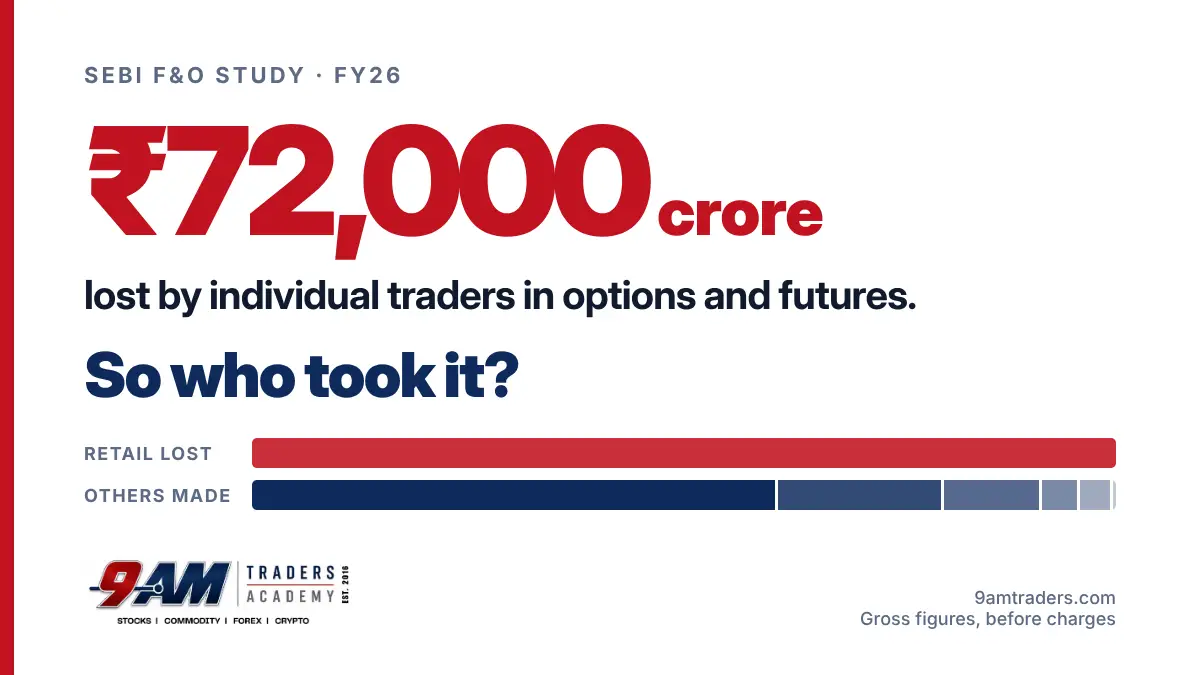
Every rupee lost in options lands in someone’s pocket. SEBI’s latest study tells us exactly whose. Individual traders lost ₹72,243 crore in FY26 before charges. Everyone else in the market made almost exactly the same amount: ₹72,244 crore.
This is not a coincidence. It is how options work. So the real question is not “how do I win?” It is “who am I playing against?”
Who is on the other side of your trade
The winners are not lucky uncles or smarter Instagram traders. They are machines with a lot of capital.
- Proprietary trading firms made ₹44,483 crore. These are firms that trade their own money full time. The top 10 of them took 75% of that profit.
- Foreign investors (FPIs) made ₹13,896 crore.
- 99% of FPI and prop-firm profits came from algorithmic trading. Computers that place orders in milliseconds, price options more precisely than any human, and never panic.
- Corporates, LLPs and mutual funds made the rest, often by hedging or selling options.
Think about what that means. When you buy a weekly option on your phone in a bus, the money you lose often ends up with firms running computers built by teams of engineers. It is not a fair fight, and it was never meant to be one.
5 habits that hand your money to them
SEBI’s data does not just show who wins. It shows how retail traders lose.
- Only buying options. 93% of individual traders used only options, and options caused 92% of their losses.
- Trading on expiry day. 59% of index options turnover happens on expiry day. Contracts with more than a week left make up only about 3%. Retail is crowding into the hours when premiums die fastest.
- Small account, huge turnover. Traders with portfolios under ₹1 lakh were 78% of all traders and took 70% of the losses. The 13% who had under ₹1 lakh but traded over ₹1 crore caused 52% of all losses alone.
- Paying the toll again and again. Individuals paid about ₹25,000 crore in charges in a single year. The STT they paid jumped 35% in FY26, and from April 2026 STT on options went up to 0.15% of the sell premium.
- Trading without owning anything. 35% of F&O traders, about 43 lakh people, held no shares at all at the end of FY26. For many, F&O was not an addition to investing. It was the whole plan.
And the people hurt most are the ones who can least afford it: 88% of traders earning under ₹5 lakh a year lost money, and 89% of traders under 30 lost money.
How to stop being the other side’s profit
You cannot out-compute an algo. You can refuse to play the game the way it is built to beat you.
- Stay away from expiry-day lottery tickets. A ₹5 option is cheap for a reason.
- Risk 1 to 2% of your trading capital per trade. If one lot is more than that, skip the trade. That is not weakness. It is maths.
- Set a daily loss limit, and stop when you hit it. Revenge trading is where small losses become big ones.
- Count the charges before you trade. Many small trades can lose money even when you are right.
- Paper trade for 30 days first. If you cannot follow your rules without money on the line, you will not follow them with it.
- Build investments before you trade. Own something. Let F&O be a small part of your money, never all of it.
- Learn from a person, not a tip. Telegram groups do not lose money when you do. A teacher who answers your questions will tell you when not to trade.
A simple test: if you cannot explain theta, breakeven and your stop-loss before you click Buy, you are not trading. You are donating.
The bottom line
The ₹72,000 crore did not vanish. It moved, from 87.5 lakh individual traders to a few thousand firms with better tools. Every time you click Buy without a plan, you are adding to that transfer.
If you are going to trade options at all, learn how they actually lose value first. Our live Options Buying course covers premiums, time decay, setups and risk in 4 classes, in Hindi and English, with a teacher who answers your doubts. Or start with a free demo class.
Share this with one friend who buys options on expiry day. It might save them more than it costs you to forward it.
Sources
- SEBI profitability study FY26, explained by 9AM
- SEBI FY26 study: trading habits that lose money
- Zerodha: STT rates from 1 April 2026
9AM Traders Academy provides stock market education only. This article is not investment advice or a recommendation to buy or sell any security. Trading in futures and options carries substantial risk. The trader in the opening story is an illustration, not a real person.