

Why the right course matters
The best stock market course in Delhi is not the one with the biggest banner or the loudest ads. It is the one that teaches you to understand the market, manage risk, and keep learning on your own after the classes end.
Delhi has hundreds of institutes, YouTube channels and weekend workshops. Fees range from a few thousand rupees to over a lakh. Some are excellent. Others sell big promises and little teaching.
This guide gives you 10 things to check, the red flags to avoid, and the questions to ask before you pay. Use it to compare any institute, including our own stock market courses.
10 things to check before you join
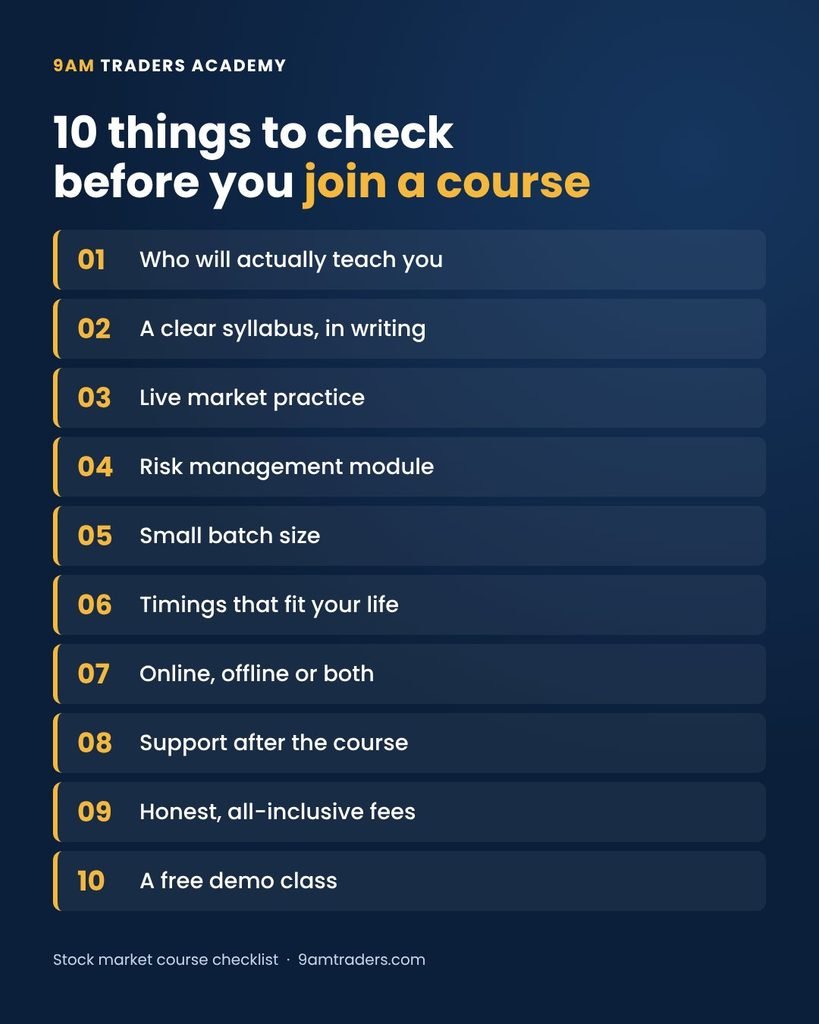
1. Who will actually teach you
Ask for the trainer’s name, not just the founder’s. Check how many years they have traded in real markets and whether they hold NISM certifications. NISM is the training body set up by SEBI, India’s market regulator.
2. A clear syllabus, in writing
A good course shares its full module list before you pay. Look for basics (how the market works, order types), technical analysis, fundamentals, options, and risk management. If they can’t show you the syllabus, walk away.
3. Live market practice
Charts on slides are not enough. Ask how many sessions happen during market hours (9:15 AM to 3:30 PM IST), and whether you practise on paper trades before using real money.
4. Risk management is a full module
Most beginners lose money because they risk too much on one trade, not because they pick bad stocks. The course should teach position sizing, stop-losses and how to set a daily loss limit.
5. Small batch size
In a class of 60, you won’t get your doubts cleared. Ask how many students sit in one batch. Fewer than 20 to 25 is a good sign.
6. Timings that fit your life
Students, working professionals and homemakers need different schedules. Check for weekday, evening and weekend batches, and whether you can switch batches if needed.
7. Online, offline or both
Classroom learning helps with discipline and live doubt-solving. Online helps if you live far away. The best option is often a choice of both, with live classes in either mode so you can ask questions in real time.
8. Support after the course ends
The real learning starts when you trade on your own. Ask if you can repeat classes, join a doubt group, or meet a mentor for some months after the course.
9. Honest, all-inclusive fees
Ask for the total fee, including GST, study material and any “advanced” modules. Watch for courses that look cheap but push expensive add-ons later.
10. A free demo class
A confident institute lets you attend one class before you pay. Use it to judge the trainer’s teaching style, the classroom, and how questions are handled. At 9AM Traders Academy, you can book a free demo class any day.
Red flags to avoid
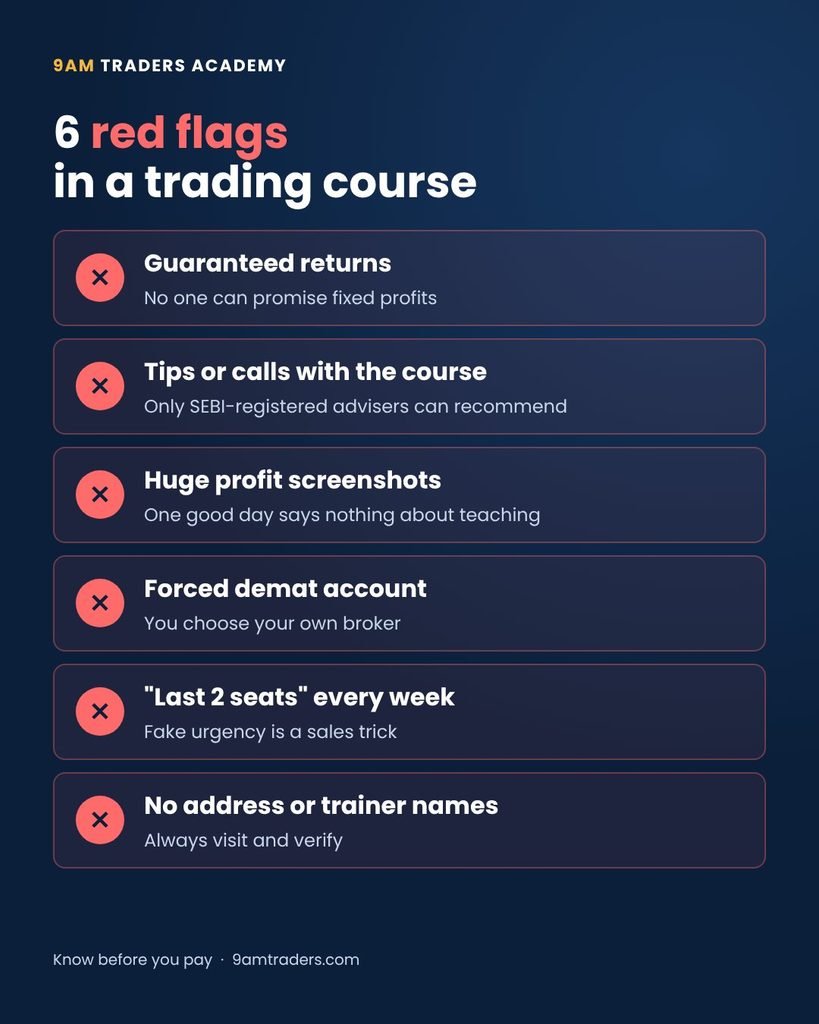
If you see any of these, think twice before paying.
- Guaranteed returns. No one can promise you will earn a fixed amount from trading. Anyone who does is selling a dream, not a course.
- “Tips” or “calls” bundled with the course. Only SEBI-registered research analysts and investment advisers can legally give buy or sell recommendations. You can check anyone’s registration on SEBI’s list of recognised intermediaries. An education institute should teach you to decide for yourself.
- Screenshots of huge profits. A P&L screenshot shows one good day, not the losses on other days. It tells you nothing about the teaching.
- Pressure to open a demat account through them. You should be free to choose any broker you like.
- “Last 2 seats” every week. Fake urgency is a sales trick. A good institute gives you time to decide.
- No address or real trainer names. If you can’t visit the classroom or check who teaches, be careful.
Questions to ask before you pay
Save this list on your phone and ask every institute you visit.
- Who will teach my batch, and how long have they traded?
- Can I see the full syllabus in writing?
- How many classes happen during live market hours?
- How many students are in one batch?
- What is the total fee, including GST and all modules?
- Are classes live, and what happens if I miss one?
- What support do I get after the course ends?
- Can I attend a free demo class first?
- What is your refund or batch-transfer policy?
- Can I talk to two or three past students?
How 9AM Traders Academy measures up
We built our courses around the same checklist. Here is how we compare, so you can judge for yourself.
| What to check | At 9AM Traders Academy |
|---|---|
| Trainer | Vijay Verma, with 15 years of experience in the stock market |
| Syllabus | Beginners: Alpha, 3 months. Advanced: Beta, 6 months. Specialist courses: Technical Analysis, Fundamental Analysis, Futures and Options, Mutual Funds, Forex and Crypto. Teens aged 14 to 17: Scout. Compare all courses |
| Live market practice | 100% live: every class is taught in real market conditions |
| Batch size | A maximum of 8 students per batch |
| Timings | Open all days, 9 AM to 6 PM IST |
| Mode | Classroom in Moti Nagar, or live online. No recordings: every class is live, so you can ask questions as you learn |
| Support after course | Full support after you finish the course |
| Fees | Depend on the course you choose. We share them openly at the free demo class |
| Location | Building No. 22 & 23, 2nd Floor, above White Pharmaceuticals, near Milan Cinema Road, New Moti Nagar, Karampura, Delhi 110015. Near Moti Nagar Metro Station (Blue Line) |
We don’t give tips or promise returns. Our job is to help you understand the market well enough to make your own decisions.
Frequently asked questions
How much does a stock market course in Delhi cost?
Fees vary widely, from short workshops of a few thousand rupees to full programmes costing ₹50,000 or more. Compare what is included, not just the price. At 9AM Traders Academy, fees depend on the course, and we share them at the free demo class. You can compare all our courses here.
How long does it take to learn trading?
Most good courses run 1 to 3 months. Becoming consistent takes longer, usually many months of practice with small amounts and a written plan.
Can a complete beginner join?
Yes. A good course starts from zero: what a share is, how NSE and BSE work, and how to place an order. You don’t need a finance or commerce background. Our 3-month Alpha course is built for complete beginners.
Is an online course as good as a classroom course?
It can be, if the classes are live and you can ask questions in real time. Classroom learning suits people who want discipline and face-to-face help.
Do I need a lot of money to start trading?
No. You can practise with paper trading first, then start with a small amount you can afford to lose. Learning risk control matters more than starting capital.
Will a course guarantee profits?
No course can. A course gives you knowledge and a process. Results depend on your discipline, practice and risk management.
Take the next step
The best way to judge any course is to sit in one class. Use the checklist above, ask your questions, and decide only when you are sure.
Book a free demo class at 9AM Traders Academy and see how we teach.
Disclaimer: This article is for educational purposes only and is not investment advice. Trading in the stock market involves risk, including loss of capital.