

9AM IPO Scan · Free IPO analyzer
IPO Analyzer: Check Any Indian IPO Before You Apply
Or pick an IPO
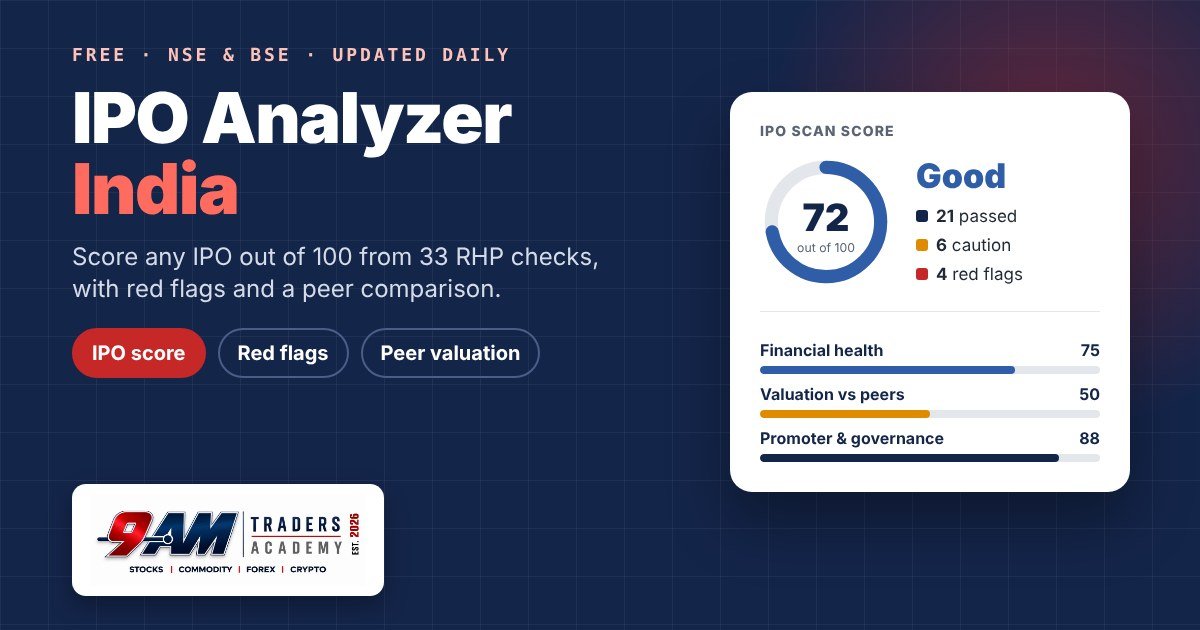
This free IPO analyzer for India checks every open and upcoming mainboard and SME IPO on NSE and BSE. Every morning our AI reads public RHP data, runs 33 checks and scores each IPO out of 100, with red flags, a peer comparison, live subscription and your chance of allotment.
Market Calendar
Upcoming corporate actions on the Indian stock market.
How to Analyse an IPO Before You Apply
Most investors apply to an IPO after seeing the grey market premium or a social media post. The real information sits in the offer document the company files with SEBI. It runs to hundreds of pages, which is why few people read it. IPO Scan reads it for you and turns it into a score, a list of red flags and a comparison with listed companies in the same business.
DRHP vs RHP: which document matters
The DRHP (Draft Red Herring Prospectus) is the first version a company files with SEBI. It describes the business, financials, risks and the planned issue, but has no dates. The RHP (Red Herring Prospectus) is the updated version filed before the issue opens. It carries the issue dates and the latest financials. IPO Scan uses RHP figures once they are published and DRHP figures before that, as reported by the exchanges and financial news sites.
What the 8 categories check
- Financial health: revenue growth, operating cash flow, working capital and debt.
- Profitability: margins, return on equity and return on capital, and whether they are improving.
- Valuation vs peers: P/E, EV/EBITDA and price to book at the upper price band.
- Promoter and governance: promoter holding after the issue, pledged shares, related-party transactions and board independence.
- Issue structure: how much is fresh issue and how much is offer for sale (OFS) by existing shareholders.
- Use of proceeds: where the fresh money goes, and whether it repays promoter-linked loans.
- Legal and litigation: pending cases against the company, promoters and directors, compared with net worth.
- Risk disclosure: auditor remarks, customer or supplier concentration, and the key risk factors.
How the IPO Scan score works
The score out of 100 is built from four parts:
- Subscription demand (50%): how many times each category is subscribed, with retail demand counting most (retail 50%, QIB 30%, NII 20%). If the retail portion or the whole issue is not fully subscribed, the overall score is capped at 25 (Weak). Before bidding opens this part is neutral, and it updates every morning while the IPO is open.
- Profit growth in the RHP (20%): how much profit after tax grew in the latest year. A big jump scores higher, so check in the report whether it came from the core business or a one-off such as an acquisition.
- P/E vs listed peers (5%): the P/E at the upper price band after the issue, compared with the median of listed peers. Cheaper than peers scores higher.
The other 25% comes from the 33 fixed checks on financial health, governance, issue structure, use of proceeds, legal cases and risks. A check we can't verify from public sources counts against the IPO, not as neutral.
Strict rules
- Subscription needs real demand: 150× or more for full marks, and under 3× scores low.
- Subscribed 150× or more overall: the IPO is always rated at least 76 (Strong).
- Each red flag takes 5 points off the score.
- 4 or more red flags: the score can't go above 50.
- P/E more than 50% above listed peers: the score can’t go above 60, unless the issue is subscribed 100× or more.
- Retail portion or whole issue not fully subscribed: the score can't go above 25.
Bands: 0–25 Weak, 26–50 Okay, 51–75 Good and 76–100 Strong. The score does not predict listing gains, and it is not a reason to apply on its own.
How to Use the IPO Analyzer
- Search the IPO. Type the first letter or the full company name. The IPO analyzer suggests matching IPOs as you type, and it also understands brand names and spelling mistakes.
- Or pick one. The buttons under the search bar show the IPOs open now and opening soon, each with its score out of 100.
- Read the report. Start with the red flags, then compare the valuation with listed peers. Every finding links to the page it came from.
- Check the RHP yourself. Use the report as a checklist, then confirm the important figures in the RHP on the SEBI website, NSE or BSE.
IPO checklist: 8 questions to ask before you apply
- Is revenue growing every year, and is profit growing with it?
- Is cash flow from operations positive, or is profit only on paper?
- Is debt to equity below 1, and is debt growing slower than revenue?
- How much of the IPO is offer for sale (OFS), where the money goes to existing shareholders and not to the company?
- Will the fresh issue fund new capacity, or mostly repay loans?
- Is the P/E at the upper price band higher than listed peers?
- What will the promoter holding be after listing, and are any promoter shares pledged?
- Does one customer or one supplier account for most of the business?
The IPO analyzer answers each of these questions with a figure and a source, so you can see in a minute where an IPO is strong and where it is weak.
Mainboard IPO vs SME IPO analysis
The same 33 checks run on mainboard and SME IPOs. SME IPOs usually publish less information, so more checks may show as "not found". When more than a third of the checks can't be verified, the report is marked as limited data and the score should be read as provisional.
GMP vs fundamentals
The grey market premium (GMP) shows short-term demand before listing. It is unofficial, it changes every day and it says nothing about the business. An IPO analysis based on the RHP looks at the company itself: growth, profit, debt, valuation and governance. Use both, but don't let GMP replace reading the fundamentals.
How to apply for an IPO in India
You can apply through your broker's app or your bank's net banking using UPI or ASBA. The money is blocked in your account, not debited, until shares are allotted. Allotment is usually finalised a day after the issue closes, and the shares list on NSE and BSE a few days later. Retail investors can apply for between one lot and ₹2 lakh worth of shares in a mainboard IPO.
Want to learn how to read an RHP and value a company yourself? Explore the stock market courses at 9AM Traders Academy.
IPO Analyzer FAQ
What are my chances of getting an IPO allotment?
Each report shows how many times the IPO is subscribed in every category and the chance that a retail investor gets shares. When the retail portion is oversubscribed, SEBI rules give the minimum application to as many retail applicants as possible, picked by lottery, so applying for more than the minimum doesn't raise your chance.
Is the IPO report free?
Yes. Every IPO report is free and needs no login.
Where does the report data come from?
Every morning our AI researches each open and upcoming IPO from public sources such as exchange notices, broker IPO notes and RHP summaries, then marks each of 33 fixed checks. Checks it can't verify count against the IPO. The score combines subscription demand (50%), profit growth (20%) and P/E vs peers (5%) with those checks (25%), and every finding links to its source. Figures may contain errors, so verify important numbers in the RHP.
Does a high score mean I should apply?
No. The score only shows how many issues were found in the offer documents. Always read the RHP, understand the business and judge the price yourself before you apply.
What if I don't know the exact spelling of the IPO?
Type the first few letters or the name as you remember it. The search corrects common spelling mistakes and also knows brand names and short forms, so you can type the name the way you remember it.
What is the difference between mainboard and SME IPOs?
Mainboard IPOs list on the main NSE and BSE platforms. SME IPOs list on NSE Emerge or BSE SME, are usually smaller, have higher minimum application amounts and can be less liquid after listing.
How do you pick peer companies?
We start with the listed peers named in the RHP's basis for issue price section, then add comparable listed companies where that list is too narrow.
Disclaimer: IPO Scan is an educational tool from 9AM Traders Academy based on public information. Reports are generated by AI from public sources and may contain errors. It is not a recommendation to apply for, buy, hold or sell any security. [SEBI registration status and number]. Read the RHP and consult a SEBI-registered adviser before investing.