

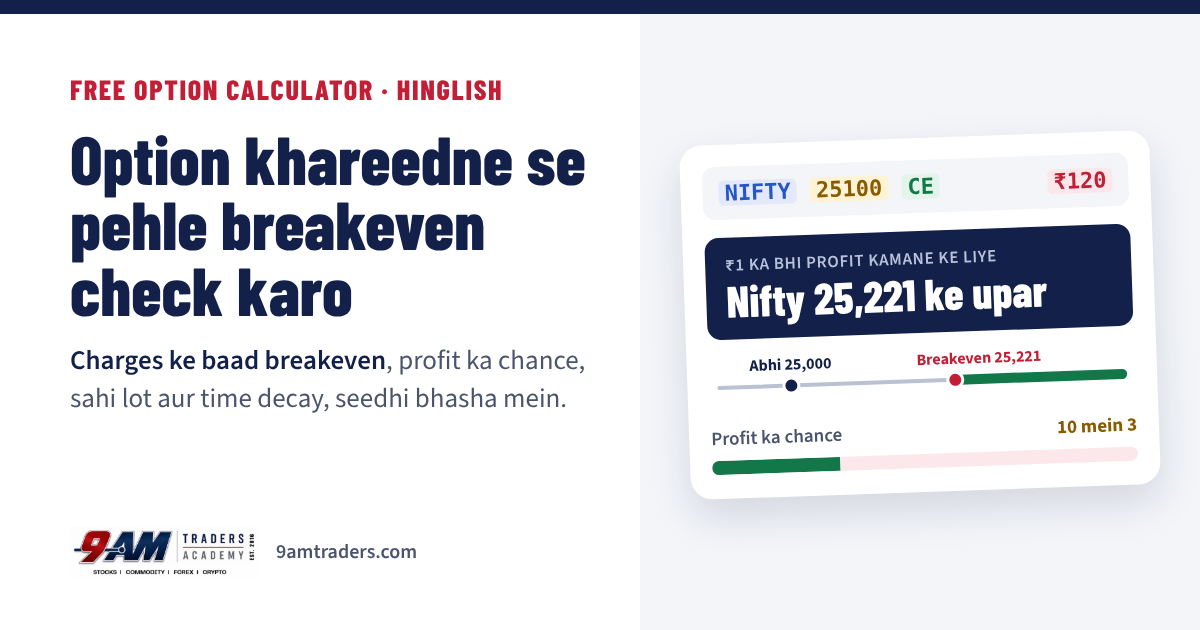
Option Buying Calculator: Breakeven, Risk and Time Decay
9 out of 10 F&O traders lose money. Type the option name from your trading app and see, in plain words, where the market must go for you to make money, and how much you can lose.
Other ways to take the same view
Same direction, same expiry, same number of lots, from a plain option buy to fully hedged spreads. Each card shows the money at stake, the most you can lose and the chance of profit, so you can see the trade-off yourself. These are calculations, not recommendations.
A higher chance of profit almost always comes with a smaller reward for the risk, so read the “Risk vs reward” line on every card. A plain option buy can lose everything you put in. Hedged trades, like the spreads below, fix your maximum loss before you enter, which makes them safer. Nothing here is risk-free: even a hedge can lose its capped amount.
Prices for other levels are estimated from the price of your option. Real prices in your app can differ, especially for far-away levels. Hedged trades need margin in your account for the option you sell, roughly the money at stake shown on the card.
If Nifty 50 moves, what do you make?
Profit or loss after all charges, if you sell the option at these levels.
If Nifty 50 doesn’t move, what do you lose?
—
This is time decay. An option loses value every day, and faster near expiry.
See every charge
NSE option rates: STT 0.15% of premium on the sell side, exchange charges 0.03553%, SEBI fee ₹10 per crore, stamp duty 0.003% on the buy side, GST 18% on brokerage and fees.
Estimates use the Black–Scholes model with the volatility implied by the price you entered. Real prices also move with volatility and demand, so treat these numbers as a guide. This calculator does not recommend any trade.
Built for your first option trade
Pro tools like Sensibull are excellent once you know the language: option chains, Greeks, payoff charts, multi-leg strategies. This calculator is for the trader who has never needed those words. It asks what you see in your app, answers in plain words, and warns you before a trade is too big for your account.
| What you need to know | Brokerage calculator | 9AM calculator |
|---|---|---|
| Brokerage, STT, GST and other charges | Yes | Yes |
| Breakeven level after all charges | No | Yes |
| Chance of making money, as “3 in 10” | No | Yes |
| How many lots fit your risk rule | No | Yes |
| What you lose if the market doesn’t move | No | Yes |
| Reads the option name you type from your app | No | Yes |
| Compares other ways to take the same view | No | Yes |
Option words, in plain language
- Spot price
- Where the index is trading right now, like Nifty at 25,000.
- Strike price
- The level in the option’s name, like 25100. A call pays at expiry only if the index ends above it.
- Premium
- The price of one unit of the option. You pay it times the lot size, so ₹120 × 65 = ₹7,800 for one Nifty lot.
- CE and PE
- CE (call) is a bet that the market goes up. PE (put) is a bet that it goes down.
- Lot size
- Options are sold in fixed bundles. One Nifty lot is 65 units, one Bank Nifty lot is 30.
- Breakeven
- The level where your profit just covers what you paid plus every charge. Before that, you are losing.
- Expiry
- The last day of the option. After it, the option is worth only what it pays at that moment, often zero.
- In the money, out of the money
- A call is “in the money” when the index is already above its level, and “out of the money” when it is below. Out-of-the-money options are cheaper because they need a move to pay anything.
- Iron condor
- Two hedged spreads, one above and one below the market. You earn if the market stays in a range, and your loss is capped if it breaks out.
- Hedge
- A second position that limits the damage if your main one goes wrong. A hedged trade has a maximum loss you know before you enter.
- Spread
- Buying one option and selling another further away. The sold option lowers your cost, but it also caps your profit.
- Time decay
- An option loses value each day even if nothing moves. That is why cheap weekly options often go to zero.
Questions traders ask
Why do most option buyers lose money?
An option buyer needs the market to move far enough, and fast enough, to beat the premium, the charges and time decay. SEBI’s study of FY2024-25 found about 91% of individual F&O traders made a net loss. Read more in Business Standard’s report on the study.
How is option breakeven calculated?
For a call, breakeven is the strike plus the premium plus the charges per unit. For a put, it is the strike minus the premium and charges. This calculator adds brokerage, STT, exchange fees, SEBI fees, stamp duty and GST on both the buy and the sell.
What is the current Nifty and Bank Nifty lot size?
Since January 2026, one Nifty 50 lot is 65 units, Bank Nifty 30, Fin Nifty 60, Midcap Nifty 120 and Nifty Next 50 is 25. The exchange reviews lot sizes from time to time, so check your broker’s contract note if in doubt.
How many lots should I buy?
Decide how much of your account you can lose on one trade, usually 1 to 2%, and divide it by the most you can lose per lot. The calculator does this for you and warns you when a trade is too big.
Is this calculator a trading tip?
No. It calculates numbers for the trade you enter. It does not recommend buying or selling anything.
Keep losing on option buys?
Learn options buying and risk management in live classes at 9AM Traders Academy, with a teacher who answers your questions. After the market closes, flip your card on 3:31 Flip to see how other traders did today.